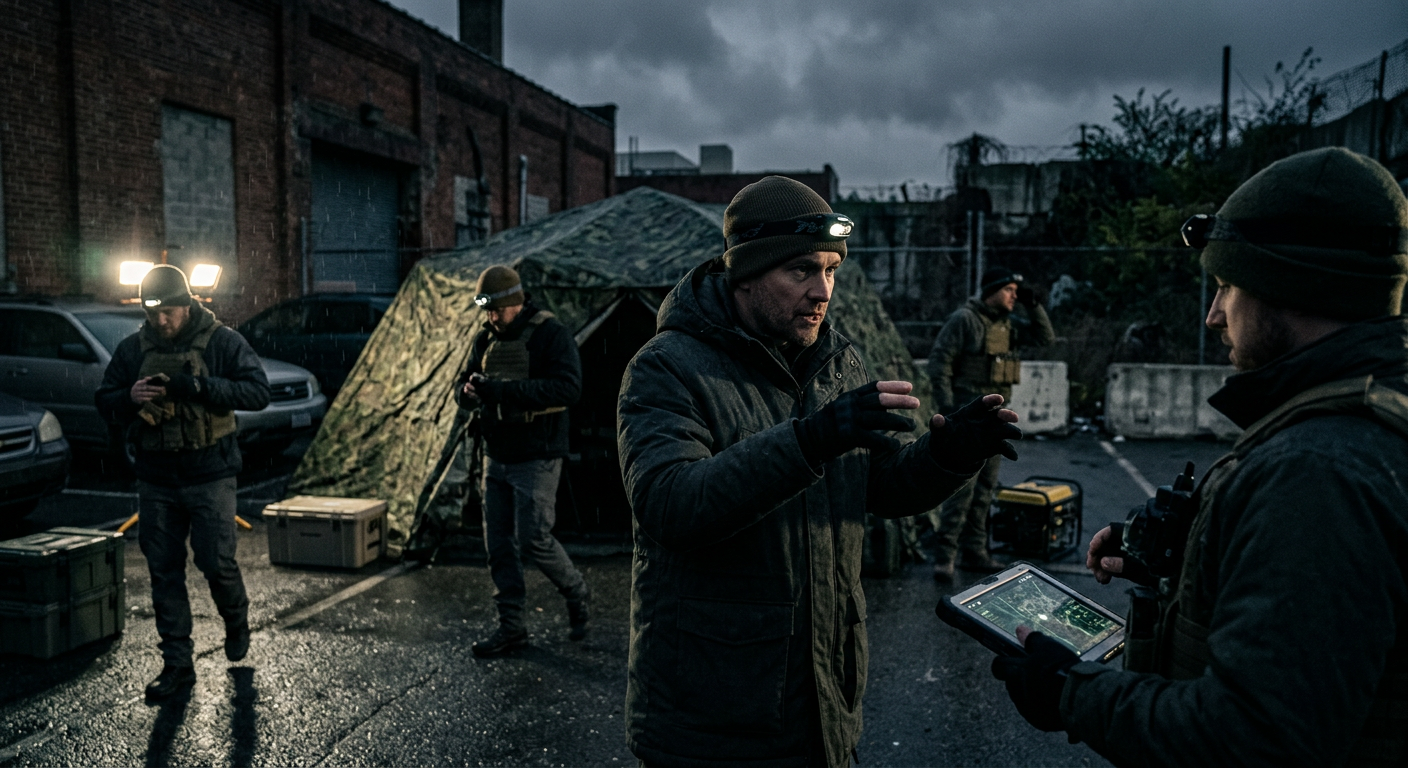
I spent decades in the Marine Corps commanding units through high-stakes crises, and one truth remains absolute whether you are in a combat zone or a grid-down neighborhood: survival requires layered defense. We cannot rely on a single wall, a single weapon, or a single plan.
Our team must understand that observation has fundamentally changed. We no longer just worry about a looter with binoculars. We face threats operating across multiple electromagnetic and digital realms. If we fail to adapt to this multi-spectrum reality, our physical preparations mean nothing.
To build genuine community resilience, we look to a framework originally detailed by vulnerability analyst Gary L. Goosey and widely utilized in military vehicle defense: the Survivability Onion. This model serves as our map for navigating hostile environments. It relies on a fallback structure. If one layer of our security fails, the next layer absorbs the impact. We memorize this framework through the "Don't Be" sequence.
Before we even peel the physical layers of this onion, we must address the invisible battlefield that gets people targeted before they even lock their doors.
The Invisible Front Line: Multi-Spectrum Cyber Security
The cyber spectrum represents our most critical vulnerability. Extreme discipline here is non-negotiable. Modern hostile actors will map your location, your resources, and your defense patterns without ever setting foot on your street.
During my time analyzing global threat responses, I watched an entire command post get destroyed because a single soldier posted a geotagged photo to Facebook. I watched the perimeters of highly classified global military installations get mapped out online because personnel wore fitness trackers like Strava while running the fence lines.
For our community, this translates directly to operational security (OPSEC). We must maintain total digital silence regarding our logistics. Turn off geotagging on your phone camera immediately. Never post images of your supply caches, your water storage, or your perimeter fortifications. If civil unrest triggers a local deployment of your neighborhood defense team, absolutely zero fitness trackers or social discovery apps can be active. Hostile elements use the background data from these devices to triangulate high-value targets.
Layer 1: Don't Be There
This represents the ultimate strategic victory. If you remove yourself from the threat's path, adversary capabilities become entirely irrelevant.
In a societal collapse or localized disaster, we achieve this through strategic avoidance. Maintain constant mobility if forced out of your primary location, keeping the threat guessing regarding your destination. If you are defending a static location, you achieve "not being there" by erasing your footprint.
Enforce strict Noise, Light, and Litter discipline. Sound travels drastically further when grid power drops and ambient city noise vanishes. A carelessly tossed wrapper or a generator running at 0200 hours acts as a flare marking your position. Maintain the absolute lowest possible electronic signature. If they cannot find our community, they cannot target our community.
Layer 2: Don't Be Detected
If circumstances force us to remain in an active threat zone, we must aggressively manage our signatures and our sensors.
Detection happens across visual, thermal, and radio spectrums. Break up the outlines of your property or your bug-out vehicles using standard camouflage, natural vegetation, and shadow management.
Radio traffic must drop to an absolute minimum. Constant chatter allows interceptors to triangulate your community command post. Use physical runners between houses or wire-based field phones whenever practical.
Understand that active security sensors often work against you. During Operation Desert Storm, Iraqi tank commanders utilized infrared (IR) spotlights to illuminate the battlefield at night. U.S. forces simply stayed just outside the effective range of those beams, using the enemy's own spotlights as beacons to track and destroy them from total safety. A massive security floodlight on your property might illuminate your yard, but it also broadcasts your exact location to anyone within a ten-mile radius. Use passive observation devices instead.
Layer 3: Don't Be Acquired or Identified
Acquisition means a threat sees a shape; identification means they confirm that shape is a target worth engaging. Our survival depends on delaying or entirely preventing that transition.
We accomplish this through Target De-prioritization. Make your vehicle, your home, or your community look completely devoid of value. If you drive a bug-out vehicle, remove the tactical stickers. Take the canvas tarps off your supply trucks to reveal an empty bed when traveling through rear areas. If your property looks heavily fortified but starving, looters will bypass you for softer, wealthier targets.
Never remain static without eyes on the perimeter. When halted, our team must deploy two-man observation and listening posts (OP/LPs). Spotting an approaching element before they spot us gives us the tactical initiative. We gain the power to choose between quietly displacing or preparing an ambush.
Layer 4: Don't Be Hit
Once an adversary identifies us and initiates contact, our focus violently shifts to kinetic mitigation.
If you stay still under fire, you die. Continuous maneuver is mandatory. Your brain must automatically identify the nearest solid cover before contact ever occurs. Every time you enter a new environment, map out your defensible points and establish Egress Planning. Where is your fallback position if the front door is breached?
We survive the initial contact through suppression and obscuration. Lay down a heavy volume of fire to break the adversary's aim, and deploy smoke grenades to shatter their line of sight. Doing nothing guarantees a casualty. You must maneuver, suppress, obscure, or assault.
Layer 5: Don't Be Penetrated
If a projectile or a hostile element strikes our position, our engineering and equipment must prevent them from reaching the soft tissue inside.
This requires relentless discipline with personal protective equipment (PPE). Never remove your body armor plates or helmets out of fatigue. During the 1993 Black Hawk Down incident in Mogadishu, a highly trained operator removed his rear ballistic plate to reduce weight. That high-risk failure of protocol cost him his life when a round struck that exact unprotected zone.
Harden your physical environments. Vehicle engineering concepts like slat armor degrade incoming munitions before they breach the hull. We apply this to our homes through reinforced door frames, ballistic film on ground-floor windows, and sandbagged fallback rooms.
Layer 6: Don't Be Killed
This final layer relies entirely on ruthless training standards, smart equipment configuration, and medical readiness. When the outer layers fail, your muscle memory takes over.
Military data confirms that vehicle rollovers represent the number one cause of preventable fatalities during training. If your bug-out vehicle suffers a catastrophic hit and goes out of control, a seatbelt acts as your primary survival tool. Wear it during every movement, no matter how short.
Audit your chest rig and backpack for snag hazards. If operating inside a vehicle, minimize the number of pouches on your chest. Follow an optimized loadout protocol: limit ammunition to three accessible magazines, mount a seatbelt cutter high on your chest, and carry a single admin pouch for critical items.
Medical gear placement decides outcomes in seconds. Position your tourniquets and trauma kits so you can reach them with either hand. Finally, practice emergency egress. Put on your full kit, sit in your vehicle, close your eyes, and practice unbuckling, opening the door, and exiting by feel alone. Keep drilling until you can do it flawlessly in total darkness.
Community Action Plan
Transforming these military concepts into civilian readiness requires immediate, physical action. Execute these specific steps to harden your local posture:
1. Purge your digital metadata. Go into your smartphone settings right now and disable location services for your camera. Audit your social media accounts and delete any photos that reveal the layout, location, or contents of your supply caches.
2. Conduct a community emissions audit. Walk your property line at 0200 hours. Identify every light source, generator hum, and reflective surface. Install blackout curtains on all windows and build baffled enclosures for your generators to mask the acoustic signature.
3. De-prioritize your transport. Strip all morale patches, tactical brand decals, and political stickers off your primary evacuation vehicles. Your truck should look exactly like every other civilian fleet vehicle on the road—unremarkable and empty.
4. Map out neighborhood observation posts. Identify two elevated, concealed positions in your neighborhood that offer overlapping fields of view over the primary access roads. Create a rotation schedule for two-man listening posts to activate immediately during a grid-down scenario.
5. Configure ambidextrous trauma kits. Relocate the tourniquet on your primary chest rig or battle belt to the centerline. Test your ability to draw and apply it to your dominant arm using only your non-dominant hand.
6. Run blind egress drills. Sit in your primary evacuation vehicle wearing your full preparedness loadout. Blindfold yourself. Practice cutting your seatbelt (using a training tool), opening the door, and clearing the vehicle solely by muscle memory. Run this drill ten times per family member.